Wendy Dearden discusses the tension between environmental aspirations for social homes and the need to boost supply
 In the lead up to the Senedd elections, our calls for a review of the Welsh Housing Quality Standard (WHQS) were quickly echoed by others in the sector. It is a difficult conversation to start, as no-one wants to be seen to be talking down action to reduce the environmental impact of our homes.
Current requirements
WHQS, which sets the requirement for existing social homes, was updated in 2023 to include the first EPC rating requirements. These were that:
- Heating systems must be economical to run and capable of heating the whole of the home to a comfortable level to a rating of EPC A (the highest EPC rating).
- A minimum rating of EPC A must be achieved across homes through the installation of measures or planned for as part of a future programme of works.
- In the interim, all homes must meet a minimum standard of EPC C by 2030.
The standards for new homes are set by the Welsh Development Quality Requirements (WDQR) and must be at EPC A. Where existing homes are being acquired and refurbished, social landlords should take all opportunities to meet the standard.
To provide context:
- In England, the new Minimum Energy Efficiency Standard (MEES) requires existing homes to achieve EPC C by 2030 in one area – fabric, heating or smart technology – and in a second area by 2039. Exemptions and extensions can apply if the works are over £10,000 per property.
- In Scotland, the Energy Efficiency Standard for Social Housing (EESSH) had been set as EPC B by December 2032 with no existing social housing below EPC D being allowed to be re-let from December 2025. These milestones are temporarily on hold pending a new Social Housing Net Zero Standard.
In both nations, new social homes have higher EPC rating requirements than existing ones.
Impact on boosting supply: cost
Audit Wales has previously reported that the cost of new development has had a clear impact on the delivery of new social homes. As the former Cabinet Secretary for Housing, Local Government and Planning Julie James said in 2023: “We could get somewhere between five and seven houses for £1 million; now we get four if we’re lucky.”
One factor is the economic impacts of the Covid-19 pandemic and the war in Ukraine pushing up construction costs. Another is the additional costs associated with the aspiration for net zero homes.
One housing association shared that the average cost of achieving an energy performance rating (EPC) of A on a new build home is on average £15,000 more than an EPC B-rated home, depending on the scale of the development and construction method. They had estimated that if the EPC target was lowered to a B rating for the 20,000 homes target, an additional 1,000 homes could have been supported with the same funding.
The financial challenge of bringing existing social homes up to WHQS will vary across different types of landlords. Local authorities and large-scale voluntary transfer associations will have significantly older housing stock in need of greater investment. Social landlords have reported to us that they face a difficult financial balancing act. Do they improve their existing stock or add to their stock through new development? Do they have the financial capacity to do both?
Impact on boosting supply: buy-backs
Our recent report Tenure Change: Turning Existing Dwellings and Buildings into Social Homes evidenced that current standards are also making many existing dwellings unviable for acquisition.
The Local Government and Housing Committee’s Social Housing Supply inquiry reported that acquisitions could be a bigger part of the supply solution if there was further flexibility on standards. It recommended that a separate standard should be developed for acquisitions which would never achieve full WDQR and WHQS but can still deliver quality.
The government’s response was that it did not want to create two tiers of accommodation standards. We would make the case that temporary accommodation could itself be regarded as a second tier of accommodation. Here, thousands of households may experience accommodation that does not even meet the lowest standards as they wait in hope for a gold standard social home.
Unfair focus on social homes
The Government has used social housing to support a testing and learning approach to decarbonising homes, with the intention of that learning being passed to other tenures.
However, the Chartered Institute of Building has called for a retrofit plan for the private housing market as lessons from initiatives focused on social homes have ‘yet to be fully applied to the private sector’. It is important to remember that more than 80% of existing homes are in private ownership.
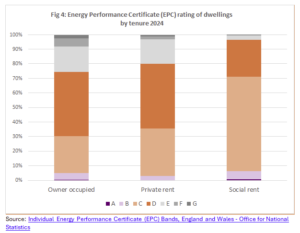
Our analysis of EPC data from 2024 reveals clear variations between different tenures and particularly between social homes and privately owned dwellings:
- Social homes were clearly the most energy efficient, with 71% of those with EPC certificates having a rating of C or above. Social homes also had the highest number of EPC A rated homes at 0.6%.
- Owner-occupied dwellings however had the highest proportion of the lowest value ratings, with 8% with an F or G rating, compared with 3% of private rents and 0.5% of social homes.
These results lead us to question why the focus is on making the best homes better, rather than targeting action at the worst?
Moving forward
It is right to ensure that tenants have the guarantee of a good-quality social home, but we must be pragmatic and led by what tenants need and want. We must also find the right balance between improving existing homes and providing for those who have no home at all.
One local government development officer described this conflict to us very succinctly: ‘Is the priority more houses? To combat homelessness? Or is it reaching net zero and saving the planet? Obviously, you want to do everything…’
In their manifesto, Plaid Cymru committed to reducing regulatory barriers to building and buying-in more social homes, including through more balanced energy efficiency requirements.
The Bevan Foundation is pleased to see this indication of pragmatism and would also like to see:
- A critical review to assess the merits of requiring all new and existing social homes to meet an EPC of A.
- The suitability of acquisitions being assessed on a property-by-property basis, balancing physical properties factor with wider considerations on demand and suitability.
- Greater flexibility in the Transitional Accommodation Capital Programme (TACP) funding requirement that a dwelling must be sold after 10 years if it does not meet WHQS.
Wendy Dearden is Senior Policy and Research Officer at the Bevan Foundation.