A historic change in Welsh politics has brought Plaid Cymru into government for the first time, with housing placed firmly at the heart of its national programme. The Cabinet Minister for Local Government, Housing and Planning, Siân Gwenllian, talks to WHQ editor Sally Hales about collaboration, new approaches and thinking beyond the short term.
 The Welsh Government has set out a packed housing programme for this Senedd term: 20,000 extra social homes, major changes to homelessness services, fairer rents in the private rented sector and continued work to upgrade the energy performance of some of Europe’s oldest homes.
The sector has broadly welcomed the ambition. Yet the reality is that housing is one of those problems that refuses to be solved by a single promise or a single policy. Costs keep climbing. The planning system remains slow. Skills gaps are felt everywhere, from site trades to professional roles. Budgets are tight,and environmental requirements, necessary as they are, add further strain to an already difficult challenge.
So the obvious question follows: can these obstacles actually be shifted in time to meet the scale of the pledge?
Siân Gwenllian, newly appointed as Wales’ housing minister, does not pretend there is an easy route through it. What she returns to, again and again, is the need for a joined-up effort, councils, housing associations and wider partners working in the same direction.
That approach sits behind Plaid Cymru’s plan for Unnos, a new arm’s-length development body. The hope is that it becomes a practical tool for housing delivery, and a way to open up options that currently feel blocked.
“As I see it, it [Unnos] is a social housing enabler to unblock some of the major problems that we’ve identified,” she says. “There are problems in planning. There are problems in finance. We need to look at innovative ways of raising finance for building more homes or acquiring more homes.”
Before taking the housing brief, Gwenllian, the MS for Arfon in north Wales, produced a series of policy papers that ranged across the right to adequate housing, renters’ protections, boosting supply and improving the energy efficiency of Welsh homes.
But it is the way decisions are made that matters to her as much as the headline commitments. She wants Unnos to be shaped with the sector, not presented to it.
“I want to be talking to people in the sector, in the RSLs and in the local authorities about what they think the remit should be. It’s not just about me saying, ‘This is what it will do.’ I’ve always worked in that way.”
Funding
Devolution gives Wales control over housing policy, but not over many of the financial decisions that sit behind it. Funding still depends heavily on Westminster, and the Barnett formula has long drawn criticism for failing to reflect Wales’ socio-economic needs.
Gwenllian says negotiations with Westminster will sit with the first minister, Rhun ap Iorwerth. Even so, she is clear that a bigger settlement from the UK Government, while welcome, will not on its own fix the housing emergency.
“It’s not all about government money,” she says. For her, Unnos is partly about widening the range of tools available, especially now that Brexit has shut off one route to long-term borrowing and investment.
“I’m eager to emphasise this, and that’s why the new body we are setting up will have the role of looking at finance,” she says. “Unfortunately, because we’re not in the European Union, we don’t have access to the European Investment Bank, which many European countries have taken advantage of. So we have to find alternative ways of financing, and I am sure there are opportunities out there.”
What those alternatives will be is still to be worked through. She does, however, want any model developed alongside the organisations that will be expected to deliver new homes.
“We’ll be looking at that in terms of the body’s purpose, structure and remit. I want to hear what people in the sector think.”
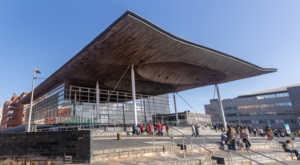
Credit: Welsh Parliament/Senedd Cymru
Delivering Net Zero
Housing associations are already living with the tension between pace and standards: building enough homes, quickly enough, while also meeting decarbonisation targets and keeping schemes affordable.
Gwenllian argues Wales is not starting from scratch. “The Warm Homes programme has been fairly successful,” she says. For her, the next step is deciding what comes after, and how it is designed.
Rather than treating each property as a separate project, she wants to look at a broader approach that works across neighbourhoods and tenure types. “I’m eager to look at area-based and tenure-neutral solutions.” Done well, improving whole communities could bring efficiencies, and it could mean the benefits extend beyond one group, reaching owner-occupiers, council tenants, housing association residents and private renters alike.
She is also keeping an eye on what is coming from Westminster. The UK Government has announced further proposals on domestic energy efficiency, and she wants clarity on how these plans will align with existing Welsh programmes.
“I want to understand how Ed Miliband’s plans will dovetail with what we’re doing in Wales, identifying where they differ and what consequentials we can achieve.”
Recent heatwaves have also shifted the way many people think about housing quality. Insulation is no longer only a winter conversation. “It’s going back to basics really about insulation,” she says. “We’re not only thinking about keeping homes warm in winter now, but how we keep them cool in summer as well.”
Rent Controls
Rent controls remain one of the most divisive housing debates, and Plaid committed in its manifesto to investigate options. The subject comes with warnings about unintended impacts, from landlords quitting the market to knock-on effects for RSL finances, and a potential slowing in social housebuilding.
“I’m very aware of the concerns around this area,” Gwenllian says. But she also links the issue directly to homelessness pressures. “Unaffordable rents in the private sector do lead to homelessness in a lot of situations.”
She insists ministers will not rush into a model before examining the evidence. Work will include looking at approaches elsewhere, including Scotland, and speaking with landlords early rather than late.
“We’re not going to rush this. Many landlords are okay about this so long as they’re involved from the beginning. There is a lot of work to be done on this, and it will be evidence-based.”
Homelessness
The new Homelessness Act is one of the most significant changes to Welsh housing law in years, shifting the centre of gravity towards prevention, stopping crises before they happen.
Gwenllian sees that as the point. “I was really happy to be involved in the Homelessness Act because the preventative side is what it’s all about.”
Officials have already begun the work of translating the legislation into services on the ground, and she expects it to push Wales further towards approaches rooted in Housing First and trauma-informed practice. “I think that will help us move on to more of a Housing First and trauma-informed basis.”
None of this comes with neat solutions. Wales is trying to expand social housing supply at scale while changing the rules on renting, decarbonising homes and reshaping homelessness services. Doing all of that will take political resolve.