POLICY DEVELOPMENTS IN OTHER PARTS OF THE UK
GREAT BRITAIN
Welsh renters hardest hit by LHA shortfalls
A greater proportion of private renters in Wales have a shortfall between their rent and their Local Housing Allowance (LHA) than any other part of the UK, according the 2026 UK Housing Review.
LHA rates were last restored to the 30th percentile of local rents in April 2024 but frozen again in April 2025 and April 2026. This means that shortfalls will inevitably increase as rents rise.
Figures published in the UK Housing Review show that 63 per cent of claimants in Wales had a shortfall in 2025, compared to 52.1 per cent in England and 39.9 per cent in Scotland. The proportion facing a shortfall in Wales was also higher than in any English region.
ENGLAND AND WALES
Draft Bill sets out plans to end leasehold
In what ministers hope will be the beginning of the end for leasehold, the UK government published its delayed draft Commonhold and Leasehold Reform Bill. The legislation includes a ban on new leasehold flats, measures to improve the alternative commonhold tenure and a £250 a year cap on ground rents for existing leaseholds. After considerable debate within government, the cap would apply for 40 years before turning into a nominal, ‘peppercorn’ rent. However, to get to the finishing line ministers will have to clear considerable obstacles both in parliament and in the courts, with lobbying and legal challenges expected from freehold investors.
ENGLAND
New homes to be zero carbon ready from 2028
The Westminster government published a Future Homes and Buildings Standard that will require heat pumps, solar panels and other energy-saving technology on all new homes.
The much-delayed standard will apply from March 2027 with a transitional period for homes that have already started construction applying until March 2028. All new homes will have to be zero carbon ready and the aim is to reduce carbon emissions by 75 per cent over 2013 levels.
Publication came almost 20 years after the previous Labour government originally announced a 2016 deadline for all new homes to be zero carbon. The policy was watered down and then scrapped under Conservative-led governments in the 2010s.
National Housing Bank starts work
Homes England’s National Housing Bank formally opened for business on April 1 in a bid to accelerate the delivery of new homes and regeneration projects.
Backed by the UK government, the National Housing Bank will work with housebuilders, developers, investors and registered providers to deploy up to £16 billion of debt, equity and guarantees. The bank will also work with Mayors through Homes England’s new regional model to strengthen collaborative working with partners and leaders.
SCOTLAND
Social housing completions fall by a quarter
Completions of affordable homes in Scotland fell 25 per cent in 2025, according to official figures.
The 3,611 completions in 2025 is the lowest annual total since 2014 and compares with 4,835 in 2024. Starts fell 15 per cent to 3,070, the lowest annual total since 1996.
The housing sector in Scotland warned that the Scottish Government is on course to break its pledge to build 110,000 affordable homes by 2032 and estimates that 15,700 social homes a year are required to meet housing demand.
Shelter Scotland director Alison Watson said: ‘No party has put forward a credible plan to deliver the homes Scotland needs, meaning politicians of all parties are planning for more people to be pushed into homelessness. We need new money and a new approach.’
NORTHERN IRELAND
Changes on the way to landlord registration
Communities minister Gordon Lyons launched a consultation on proposals to strengthen the Landlord Registration Scheme.
More than 130,000 homes in Northern Ireland are privately rented and the sector is seen as playing a key part in giving everyone access to a good quality, affordable and sustainable home.
Private landlords have been subject to registration since 2014 and proposed changes collecting information on property standards at registration and sharing register data to support gas safety enforcement and housing policy development.
WELSH GOVERNMENT
Manifestos published as election campaign kicks off
The main parties set out their priorities for housing in manifestos published ahead of the Senedd election on May 7.
With a new electoral system in place and the polls suggesting a range of possible results, all six main manifestos were drawing attention across the sector.
The current Senedd ended on April 9 and this issue of WHQ is published in the middle of the election campaign.
Senedd passes homelessness and building safety laws
Two major pieces of legislation affecting housing got Royal Assent in early April after being passed in the Senedd.
The Homelessness and Social Housing Allocations (Wales) Act includes the abolition of ‘priority need’ and ‘intentionality’ tests that can block people from getting the support they need when facing homelessness. It also provides a stronger focus on preventing homelessness, a commitment to ensuring support and allocations are tailored to people’s individual needs and routes for better joint-working across sectors.
Shelter Cymru expressed its appreciation for the work of the Welsh Government and Members of the Senedd from all parties in creating and refining the Bill.
Ruth Power, Shelter Cymru chief executive, said: ‘Today, Wales has taken an important step towards achieving our shared ambition to make homelessness rare, brief, and non-recurring.
Matt Downie, chief executive of Crisis, said: ‘This is truly a landmark day in Wales. The new Homelessness and Social Housing Allocations Bill has the potential to be life-changing for the thousands of people across Wales that are facing the trauma that comes from living without a stable place to call home.
The Building Safety (Wales) Act — considered to be one of the largest pieces of legislation ever considered by the Senedd – is broader in scope and ambition than equivalent legislation in England delivers on the Welsh Government’s commitment to make building safety a guiding principle for how homes and buildings are managed across the country.
The legislation was born out of the 2017 Grenfell Tower tragedy, in which 72 people lost their lives. The aim is to ensure that the failures which contributed to that disaster can never be repeated in Wales. The Senedd gave Stage 4 approval in March.
New estimates reveal surge in housing need
Wales needs significantly more new homes than previously thought, according to new estimates of housing need released in February by the Welsh Government.
The 2025-based estimates suggest a need for 9,400 additional housing units to meet existing unmet housing need from homeless households in temporary accommodation or living in overcrowded and concealed households.
In addition to that, the principal projection for newly-arising need between July 2025 and June 2030 is for 8,700 additional housing units per year.
The figure for unmet existing need represents a 64 per cent increase on previous, 2019-based estimates. This is the result of more people becoming homeless and living in temporary accommodation, especially since the ‘no one left out’ approach to homelessness adopted during the pandemic.
The 8,700 a year central estimate for future housing need over the next five years represents a 38 per cent increase on the 2019-based estimate of 6,300 a year between 2019 and 2024.
This reflects higher projected household growth in 2022-based household projections published in late November. This projection was driven mostly by an increase in one-person households, especially among older people.
The estimates suggest that over the next five years, 65 per cent of newly arising need (5,700 additional homes a year) will be for market housing and 35 per cent for affordable housing (3,000). All of the unmet existing need is estimated to require affordable housing.
Ombudsman launches damp and mould investigations
The Public Service Ombudsman confirmed that it will go ahead with two own initiative investigations into how social landlords respond to reports of disrepair, with a particular focus on damp and mould affecting vulnerable tenants.
The decision follows a public consultation launched in November 2025. Responses were received from tenants, local authorities, registered social landlords, Welsh Government and third sector advice and advocacy organisations.
The ombudsman’s casework and investigations had identified delays and inconsistent responses to reports of disrepair, damp and mould, often involving vulnerable tenants. In 2024/25, just over 19 per cent of new complaints received related to social housing, many concerning disrepair, damp and mould.
Evidence from the consultation indicates vulnerable tenants may be disproportionately affected, including disabled people, older people, families with children, those on low incomes and people from diverse ethnic backgrounds. Respondents described the serious impact that unresolved disrepair, damp and mould can have on health, wellbeing and independence, and agreed that progressing these investigations would be in the public interest.
Michelle Morris, Public Services Ombudsman for Wales, said: ‘While the sector is changing, including the updated Welsh Housing Quality Standard coming into force in April 2026, the evidence suggests problems persist. These proposed investigations will identify learning and support improvement, transparency and accountability.’
Committee signs off with rallying cry on social housing
An all-party Senedd committee said that the Welsh Government is on course to meet its 20,000 social homes target but warned that the housing system is still in crisis.
The Local Government and Housing Committee welcomed progress so far but said it had also heard evidence of slow progress in implementing the recommendations of the Affordable Housing Taskforce.
In a letter to housing secretary Jayne Bryant, committee chair John Griffiths highlighted a wide-ranging set of issues raised in evidence sessions and written submissions in the follow-up to its inquiry into social housing supply in 2024.
He said witnesses had highlighted the need for ‘stronger leadership from the Welsh Government to ensure the housing emergency is understood as a shared, cross-cutting priority’.
There was a need for ‘clear and consistent communication’ to make social housing supply a top priority throughout all areas of government.
And he added that the committee believed that ‘bringing the right to adequate housing into Welsh law would help establish this as an essential priority across the whole of Welsh Government’.
On the 20,000 target, all witnesses were confident that the goal will be met by the end of 2026 but some questioned whether the increase in delivery was the result of an ‘unsustainable level’ of resource input.
The committee reiterated its recommendation – accepted in principle by Welsh Government – of a target that social housing should make up 20 per cent of the housing stock.
And it called again for a recommendation rejected by the Welsh Government that it should set up a National Development Corporation to give focus to the social and affordable homes programme.
Rent convergence study launched
Housing secretary Jayne Bryant commissioned Savills to carry out research into whether a policy of rent convergence would be appropriate for Wales.
The decision follows the new rent and service charge standard for 2026 to 2036 in the Autumn and she explained that: ‘Stakeholders have highlighted the potential for rent convergence to generate additional income, and some have also made the case that rent convergence could lead to greater fairness for tenants.
‘However, I am clear that rent convergence is inherently complex. There are significant implications for affordability, existing funding arrangements, and the interaction with systems such as Local Housing Allowance and welfare support. Any consideration of rent convergence must therefore begin with affordability, not growth.’
The research will explore the potential benefits, the risks, and the practical implications of any future approach, ensuring that we fully understand the complexities before reaching any conclusions.
New criteria for registering RSLs in Wales
The Welsh Government published criteria for registration of new registered social landlords in Wales in March in a bid to ensure ‘a transparent, fair and consistent application process’.
The criteria set out two key stages: first, applicants must demonstrate they meet statutory eligibility requirements; they are then assessed against wider criteria, including governance, management arrangements, and financial viability. Applicants may provide additional information where needed, and a final recommendation is made based on the totality of this evidence.
WALES
Joint venture teams up for Plasdŵr
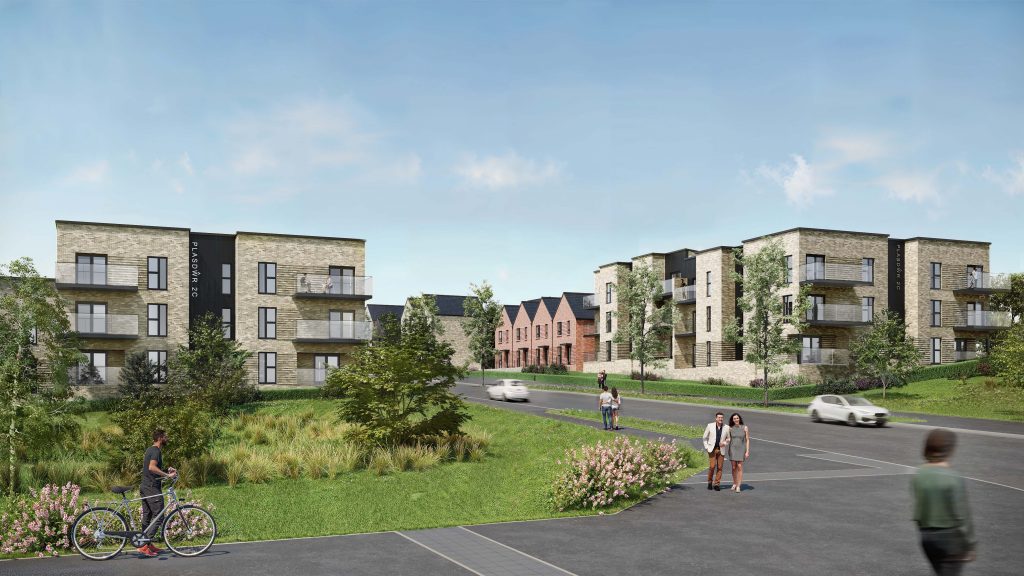 Work on the latest phase of Plasdŵr – Cardiff’s landmark Garden City – will start this summer under a joint venture between Edenstone Group and Codi Group.
The partnership received reserved matters consent in February to build 184 new homes at Porth yr Awen on Parcel 2C of Plasdŵr. The wider flagship £2 billion regeneration project will eventually provide 7,000 homes across a 900-acre site in north-west Cardiff.
The Edenstone and Codi £55 million development will help address strong local housing demand, while supporting Cardiff’s long-term growth plans, by offering homes in a mix of tenures. The approved scheme will provide 127 open market properties and 57 affordable homes.
Designed as a contemporary, urban neighbourhood, Porth yr Awen will combine modern housing with thoughtfully integrated green spaces and landscaped features that shape a welcoming community environment.
Apartment buildings with striking multi-level, full-height bay windows will frame either side of the entrance, overlooking landscaped green space and attenuation ponds to create a distinctive sense of arrival.
Beyond this, the development will feature a mix of two and three-storey homes, including gable-fronted townhouse-style buildings, all designed to reflect the established architectural character and material palette set out for the wider Plasdŵr neighbourhood.
CCR backs energy firm
Cardiff Capital Region’s innovation fund announced an investment into Sero, the Cardiff-based energy innovation company.
Sero helps social housing landlords and partners deliver energy-efficient, net-zero homes at scale, to lower bills, improve energy performance and cut carbon emissions. The company blends retrofit and energy expertise with proprietary technology that spans strategy support to ongoing energy management services.
The firm currently works with local councils and social housing providers to provide energy services and retrofit in up to 2,500 homes, with a further contracted pipeline of up to 10,000 homes.
This investment, which is part of Sero’s latest funding round, is part of the commitment of CCR’s Innovation Investment Capital Limited Partnership (IIP) commitment to backing scalable, mission-driven enterprises that are pioneering innovative solutions with measurable environmental and social impact across the region.
IIC was launched in November 2022 with an initial £50 million from UK Government funds and Cardiff Capital Region (CCR) to provide long-term capital for innovative and sustainable growth opportunities across CCR’s ten unitary authorities. Capricorn Fund Managers (CFM) serves as the Alternative Investment Fund Manager (AIFM), overseeing portfolio and risk management, with PwC advising on investment research and sourcing, on behalf of CFM.
Big plans for redundant railway site
 A disused former railway site in Bridgend is set to be transformed into 21 energy-efficient homes for social rent as Valleys to Coast moves forward with plans for Croft Goch Road, Kenfig Hill.
The development will regenerate a brownfield site with historic railway use, bringing redundant land back into productive use while supporting local housing needs. The scheme is being delivered with support from Bridgend County Borough Council, which played a key role in securing funding through the Welsh Government’s Social Housing Grant programme.
The site is well located to support sustainable living, with active travel links connecting residents to Pyle, North Cornelly and Kenfig Hill, as well as access to local schools, shops and Pyle railway station.
Sustainability is central to the scheme, with homes to be built using modern methods of construction (MMC) timber frames, alongside air source heat pumps and solar PV systems to reduce carbon emissions and help lower energy costs for residents.
Enabling works, including road construction, are already underway, with the team from Valleys to Coast and contractor P&P Builders pictured, and the first homes expected to be completed by late 2027.
New social homes underway in Blackwood
 United Welsh has started work on a project to deliver 58 new energy‑efficient apartments for social rent in Blackwood town centre.
The Lower Plas Court development, located on land close to Blackwood Market and next to the town’s bus station interchange, will consist of one three‑storey and one five‑storey apartment block. Its central location will place residents within easy reach of shops, services and public transport, helping people remain connected to the town centre.
The development is being delivered by United Welsh in partnership with Welsh Government and Caerphilly County Borough Council.
All homes will be off‑gas and built to high levels of energy efficiency, with timber frame structures for the homes from Celtic Off-Site’s factory in Caerphilly. This will be the largest apartment block produced by Celtic Offsite to date.
10 PUBLICATIONS TO LOOK OUT FOR
1 Welsh Housing Monitor
Welsh Government, Chartered Institute of Housing Cymru, March 2026
www.gov.wales/welsh-housing-monitor
2 UK Housing Review 2026
Chartered Institute of Housing, March 2026
3 Tenure change: turning existing dwellings into social homes
Bevan Foundation, March 2026
www.bevanfoundation.org/resources/tenure-change/
4 Who should own the land? Housing, power and the deep politics of land value capture
UK Collaborative Centre for Housing Evidence, April 2026
5 Build up, not trickle down: the case for need-led housing policy
Shelter, February 2026
6 More Homes Scotland: Debating a new housing agency
UK Collaborative Centre for Housing Evidence (CaCHE), March 2026
housingevidence.ac.uk/project/more-homes-scotland-debating-a-new-housing-agency/
7 Yes in our back yard: the case for community-led housing
Co-operative Party, March 2026
8 The benefits of youth? Young people, supported housing, affordability and employment
Commonweal Housing and Spring Housing Association, March 2026
9 The extent of furniture poverty 2026
End Furniture Poverty, March 2026
endfurniturepoverty.org/research-the-extent-of-furniture-poverty-2026/
10 Replacing empty spaces with productive, green places
London School of Economics, March 2026
sticerd.lse.ac.uk/CASE/_NEW/PUBLICATIONS/abstract/?index=12134