Edward Shepherd explores what Wales policymakers can learn from the English experience of land value capture.
 Given the sobering numbers in the Welsh Government’s latest estimates of official housing need, any new government formed following the May 2026 Senedd elections will inherit an enormous challenge. The latest estimates indicate that approximately 8,700 additional homes will be needed each year over the next Senedd parliament to June 2030 (with a 65/35 market/affordable tenure split). These numbers are in addition to the existing unmet need of 9,400 affordable homes. When compared to the 5,000 or so homes that StatsWales data suggest have been built on average each year since 2021, the scale of the challenge becomes painfully apparent.
This has prompted the likes of the Home Builders Federation to make their usual calls for extending demand side subsidy Help to Buy and adjusting the planning system to enable more planning consents to be granted. However, even if such measures are adopted by the next government and do result in a significant increase in housing delivery (rather than primarily boosting the profits of larger housebuilders), they are unlikely to deliver a significant increase in affordable housing supply without stronger land value capture and viability policy.
Land value capture refers to policies that enable public authorities to socially redistribute increases in development land values that result from public action such as the grant of planning permission for a more valuable land use.[1] The current dominant policy mechanism for achieving this in Wales is Section 106 (also known as planning obligations) which is predominately used to secure affordable housing contributions in cash or in kind. The Community Infrastructure Levy (a charge per square metre of new floorspace used to secure payments towards infrastructure) is also in operation in Wales but has only been adopted by a handful of authorities.
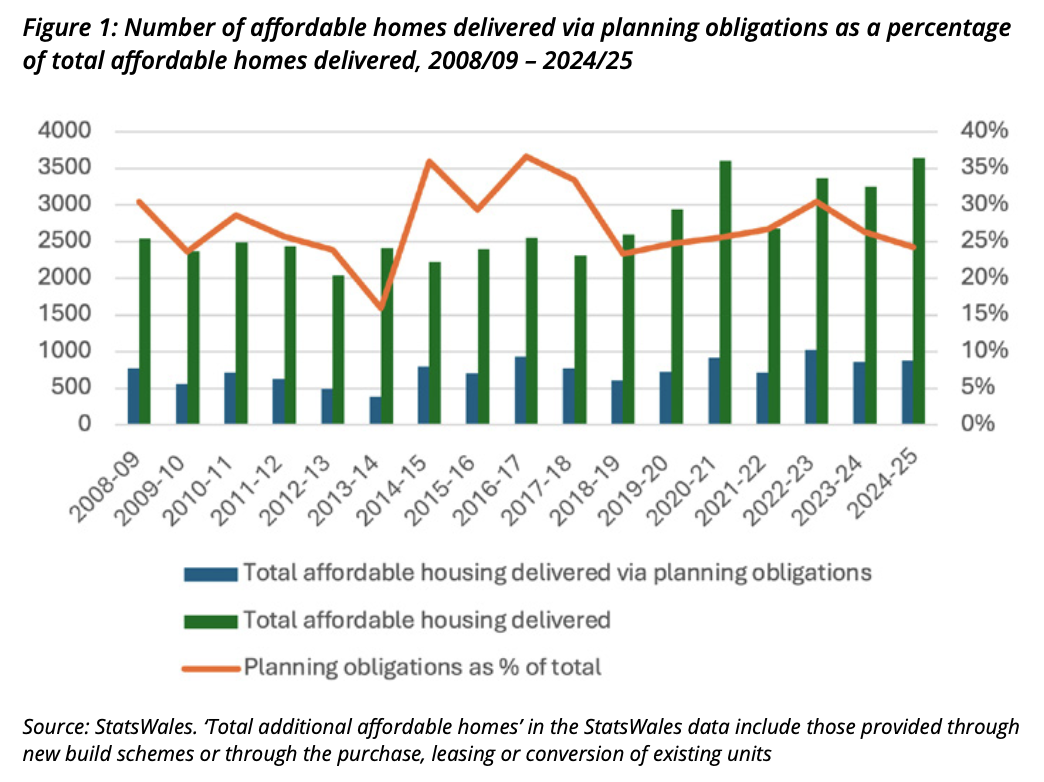
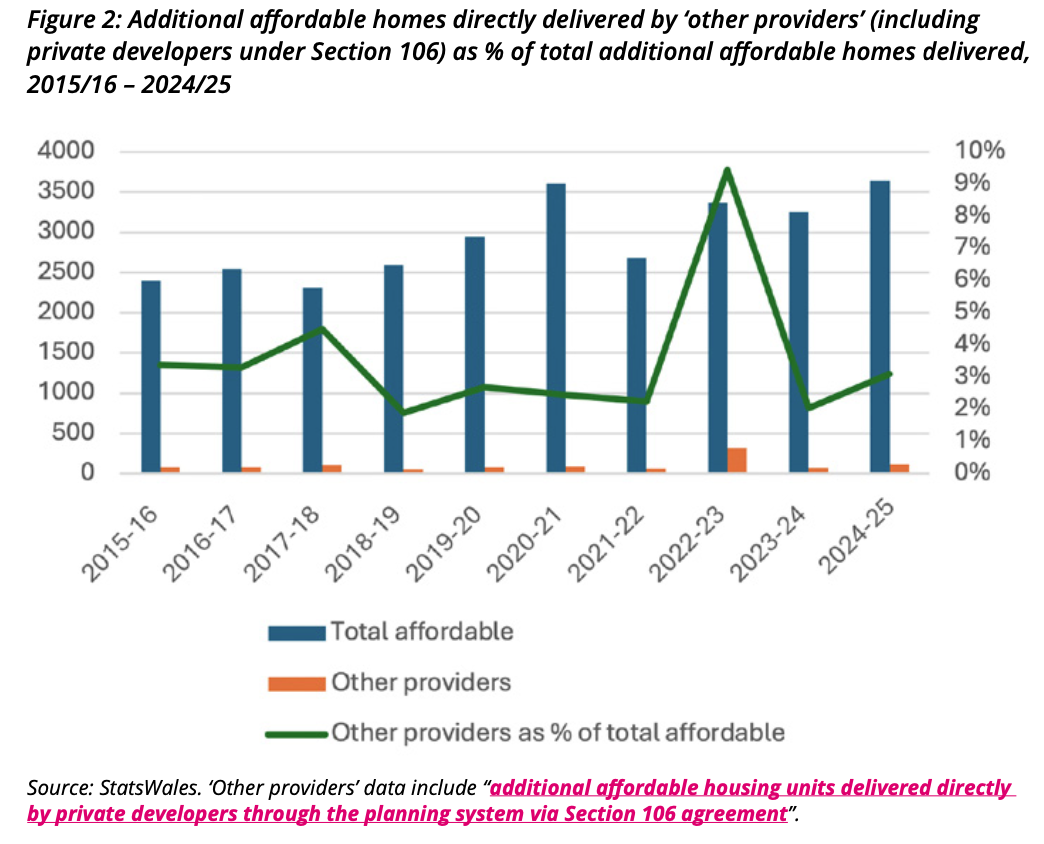
Housebuilder advocates like to quote the (unsourced) statistic that Section 106 contributed 45 per cent of affordable homes in Wales between 2021 and 2023 as evidence that private housebuilders have been doing their part. However, this is misleading. StatsWales data show that between 2021-22 and 2022-23 planning obligations delivered 29 per cent of all new affordable homes in Wales (see Figure 1). Furthermore, these data include schemes involving local authorities and registered social landlords (RSLs) that include some market tenure homes, and so are not necessarily an accurate representation of the numbers of affordable homes directly secured from private housebuilders via Section 106. When focusing only on affordable housing directly delivered by ‘other providers’ (a category in the StatsWales data which includes private developers), such entities only accounted for 6 per cent of all new affordable housing in Wales over the same period (see Figure 2). Although some of this significant discrepancy between the ‘other providers’ and the ‘planning obligations’ data could be explained by ambiguities in data collection and reporting[2], these numbers suggest that we should not accept unsourced housebuilder claims at face value and that there is a need for better national data on these issues.
The contradictory politics of viability
In any case, a key reason that it can be challenging to secure significant increases in affordable housing contributions from private housebuilders is because of development viability. Viability for planning is the process by which development is assessed to determine whether the value that is predicted to be created by the development can cover the costs of delivery. These costs include a range of construction, professional fees, finance and other costs, as well as developer profit and the land payment. In viability assessments for planning, the land payment is modelled via a fictional ‘benchmark land value’ which is the minimum price it is assumed a landowner would require to release the land for development. If these costs cannot be covered, then developers can argue that the development is unviable and so it may not go ahead.
To mitigate this risk, national policy in Wales requires that sites allocated in the local development plan should be viability tested to ensure that any land value capture contributions (such as affordable housing) can be met by the developer. However, this process can be politically fraught and technically impenetrable to the non-expert. Local authorities are often reliant on the advice of market participants (including land agents working on commission) who have an interest in protecting land values against the demands of policy.[3] Furthermore, there are often (re)negotiations at planning application stage in which developers seek to reduce their policy contributions on viability grounds.
In viability negotiations, a key area of contention can be at what level the benchmark land value should be set. Developers are incentivised to adopt a higher figure so that less development value can flow towards planning obligations. Meanwhile, local authorities are incentivised to adopt a lower figure so that there is more development value available to cover affordable housing and infrastructure payments. Clearly, therefore, there is a lot riding on how benchmark land value is determined with the power balance in favour of those who can represent themselves as knowledgeable about the land market and the demands of landowners.
The level at which land value capture contributions are set combined with the value expectations of landowners are therefore fundamental to housing supply. They can impact the supply of housing overall if they are perceived to render development unviable such that it becomes ‘stalled’. They can also impact the supply of affordable and social housing if viability arguments are successfully made at plan-making and applications stage that seek to reduce such contributions. In the context of a housing supply emergency like the one faced by the current and future Welsh government, this creates a contradictory policy bind.
On one hand, policymakers may be keen to set ambitious and rigorously enforced affordable housing policy targets to seek to ensure that the land value uplifts from any increased housing delivery are redistributed to help meet social housing need. On the other hand, they will also be keen to ensure that land value capture policy requirements are not ‘stalling’ sites due to viability impacts. Indeed, in England (where development viability has been a vexed issue largely due to developers gaming the system to reduce their affordable housing liabilities), this contradictory nature of the policy is tying the government in knots.
In the space of a few months, the Westminster government has consulted on reducing affordable housing thresholds in London in the context of a significant decline in delivery, while at the same time consulting on changes to national viability guidance to reduce the scope for developers to game the system, such as by misrepresenting their profit and not modelling improved viability from future value growth on long-term schemes. The reduction of the affordable housing threshold in London is in response to developers claiming that housebuilding is under viability pressure from rising build costs and landowners opting to hold on to land rather than sell it for a reduced price. However, the government’s recent consultation on English national viability policy is in response to compelling evidence that, in fact, developers in London are still willing to pay high prices for development sites due to their ability to misrepresent viability at planning application stage.
The Welsh policy vacuum

The next Welsh government may find itself seeking to manage similar tensions. However, its ability to do so will be significantly hampered by its lack of detailed policy guidance on viability. Whereas England has had extensive national viability guidance since 2014 that was updated in 2018 to clarify how benchmark land value should be determined to seek to ensure that affordable housing policy requirements are fully reflected in land prices, the same is not true of Wales. The closest Wales has to national viability guidance is some general wording in the Development Plans Manual Edition 3. Because of the lack of detail, the guidance leaves wide scope for developer and landowner interests to manipulate the system and bake in land values at levels that inhibit affordable housing supply in ways that the English guidance has sought to better manage. Its vague statements about how benchmark land values should be determined are especially problematic, particularly given it encourages the use of prices paid for comparable land as evidence. It was precisely this that the English national viability guidance was updated to discourage, as it can have the effect of inflating benchmark land values at the expense of affordable housing.
In the absence of national viability guidance, the Planning Officers Society Wales has admirably sought to fill the vacuum by commissioning an expert independent viability consultant to write some guidance that it hopes will be used by local planning authorities in Wales. However, it would surely be better for a document that has the potential to have a significant impact on affordable housing supply to be formally and openly drafted as public policy and put out to public consultation to be subjected to a range of views. It is encouraging that in its recent progress update on the May 2025 Affordable Housing Taskforce recommendations, the Welsh government has proposed to convene a working group encompassing more than one perspective to review viability policy and models in Wales, focusing particularly on benchmark land value.
Distrust and lack of transparency
One way in which Wales is similar to England is the degree to which viability practice is beset by distrust and suspicion. This was a key theme that emerged in a workshop held at Cardiff University in Summer 2025 on land value capture and viability in Wales. Attended by 19 practitioners from Welsh government, local authorities and the private and third sectors, the discussion frequently focused on the degree to which local authorities can distrust the viability claims put forward by developers. This is exacerbated by the opacity of the land market and the difficulty in assessing the accuracy and reliability of key figures in a viability calculation, such as build costs and benchmark land values.
There is also the problem of distrust of the planning system by the general public. This risk is exacerbated by the technical complexity of viability and the related calculations, such that the non-expert can find the policy area impenetrable. This problem is made worse by the secrecy with which viability is treated. In England, there is a national requirement for local authorities to publicly publish viability assessments and associated evidence to improve transparency, accountability and public trust. However, there is no such requirement in Wales with the government repeatedly ignoring calls for more transparency. This means it is challenging to robustly investigate viability practice and its influence on development outcomes in Wales.
This issue also came up at last year’s workshop with housebuilder interests claiming that viability evidence should not be made public as it is commercially sensitive. However, as the current English guidance acknowledges, this need not be the case. Furthermore, viability assessments and associated evidence are extremely powerful tools in setting public policy and shaping affordable housing outcomes, and so they should be subject to public scrutiny.
Taking the issue seriously?
It may seem strange that viability policy is one area in which England has a more progressive framework than Wales. This is surely partly to do with the fact that the ‘size of the prize’ is much larger in London where local authorities such as the London Borough of Islington have been instrumental in pushing the matter up the policy agenda and securing changes to national planning guidance. It is also thanks to clever campaigning by the likes of Shelter and others during the Conservative era in England to make arguments that would appeal across the political spectrum. Who could object to trying to make the system work more fairly so that better quality places can be delivered that might secure more local political support, rather than allowing all that extra development value to be extracted by landowners and ‘unscrupulous developers’ gaming the system?
While it is true that the scale of the issue will be more modest in Wales than in London when measured purely by the number of zeros in the land values, this is no reason not to take the matter more seriously here. Indeed, land value capture policy in Wales (particularly relating to viability) has suffered from neglect as a result of not being the subject of the kind of public campaigning that resulted in improvements to the policy framework in England. Although it is difficult to rigorously scrutinise viability practice due to the lack of public availability of the evidence, as a matter of principle the Welsh government should tighten guidance and provide much more detail on important matters regarding modelling future value growth, developer profit, build costs and benchmark land values with a view to ensuring that the power balance is tipped more in favour of infrastructure delivery and better quality places than inflating land values. This should be an objective that appeals regardless of which political parties are in power.
Principles for policymakers
To sum up, to ensure that the existing land value capture policy framework works more effectively to deliver the affordable housing and infrastructure the country needs with better accountability, any future Welsh government should do the following:
- Produce clear and comprehensive national viability guidance for planning for Wales to seek to ensure that public policy objectives are met and are not unduly suppressed by landowner expectations regarding financial return and developers exploiting market opacity and ambiguous assumptions. Such guidance should be formally produced as a public policy document (for example, as a Technical Advice Note) and put out to public consultation so that it can be shaped by a range of views. Once adopted, any guidance update should be supported and embedded through training and resourcing to upskill local authorities in this area.
- Introduce a national requirement that viability assessments and associated evidence are made publicly available to improve transparency and legitimacy and enable robust research on viability practice. Currently, it is difficult to access good data on how viability for planning is being conducted, particularly at planning application stage. This would be essential evidence for the design of policy and monitoring its effectiveness.
- Introduce a requirement for a centralised land market and viability database that includes sales and build cost data, as well as land price and benchmark land value data. Although there is an existing Build Cost Information Service via the Royal Institution of Chartered Surveyors, this is behind a paywall, can be unreliable and is not generally contributed to by the volume housebuilders.
Further recommendations as well as a full account of the discussions at last year’s workshop can be found in our recent report. However, while important, these kinds of adjustments will be merely tweaks to a structurally flawed system. What is really needed is a much more proactive public sector role in strategic land assembly and direct delivery of social housing. While there should certainly be a role for the private sector, the speculative development model will never deliver the numbers that are required to meet social need. There is an opportunity, therefore, for a fundamental rethink of the role of the state and how to leverage its power and access to cheap borrowing to support public housing objectives that can deliver economic growth.
This could include, for example, supporting land acquisition net of hope value[4] and empowering the development corporation model to lead on land assembly to be paid for out of future value growth. There are already enabling powers in the Levelling Up and Regeneration Act 2023 that mean this approach could be used in Wales.[5] The formation of a new government later this year surely offers a good opportunity for a policy re-set and the injection of a fresh set of ideas oriented towards realigning the power relations in the land market and in the housebuilding sector so that more and better quality (social) housing and better places can be delivered to meet social need.
Dr Edward Shepherd is senior lecturer in planning and development at Cardiff University
[1] This is a deliberately limited definition for the purposes of the current discussion. A broader definition could include general property taxation that includes land, such as council tax, non-domestic rates, inheritance tax, capital gains tax and so on.
[2] For example, it may be that the ‘other providers’ data under-count private developer contributions towards affordable housing delivery as it may not always take into account homes constructed by RSLs or local authorities as part of a Section 106 agreement entered into with a private developer. There is a real need for better data collection by the government to arrive at a more accurate picture of the various sources of new affordable homes and their respective tenures so as to arrive at an accurate and independent understanding of the contributions made by private housebuilders.
[3] Appendix 3 to the Bridgend Local Development Plan 2018-2019 Plan-Wide Viability Assessment 2021 contains a clear example of this. A letter from Savills dated 15 July 2020 states that, in its view, the benchmark land values originally proposed for plan-making were too low ‘based principally on information from minimum price clauses within option agreements’ (among other evidence). This advice resulted in uniform increases to benchmark land values for plan-making that will have reduced thevalue headroom available to support the delivery of affordable housing within the local authority.
[4] We define hope value as the segment of land value (in excess of the value of the land only taking account of its existing use) that derives from the prospect of planning permission for development to a more valuable land use.
[5] While the hope value provisions represent an important change to the land and development legal framework, these powers may be no panacea. They are unlikely to be used where a private housebuilder is involved and cannot currently be used in public-private partnership infrastructure delivery models. Furthermore, there is likely to have to be a test case to unequivocally establish the legal principle (disputed by some) and thereby have the desired effect of disciplining the land market to enable acquisition of land at ‘fairer’ values underpinned by the threat (if not the execution) of compulsory purchase. Finally, without a significant funding commitment to support the actual use of compulsory purchase at scale and therefore lend weight to such negotiations, these desired effects may not materialise. This all indicates the potential of a properly funded development corporation-style public sector led land assembly and long-term stewardship agenda to deliver high quality and tenure diverse places.