Wales needs significantly more new homes than previously thought, according to new estimates of housing need released by the Welsh Government.
The 2025-based estimates published on Thursday suggest a need for 9,400 additional housing units to meet existing unmet housing need from homeless households in temporary accommodation or living in overcrowded and concealed households.
In addition to that, the principal projection for newly-arising need between July 2025 and June 2030 is for 8,700 additional housing units per year.
The annual estimates for existing unmet and for newly arising housing need over the next 20 years are summarised in this table:
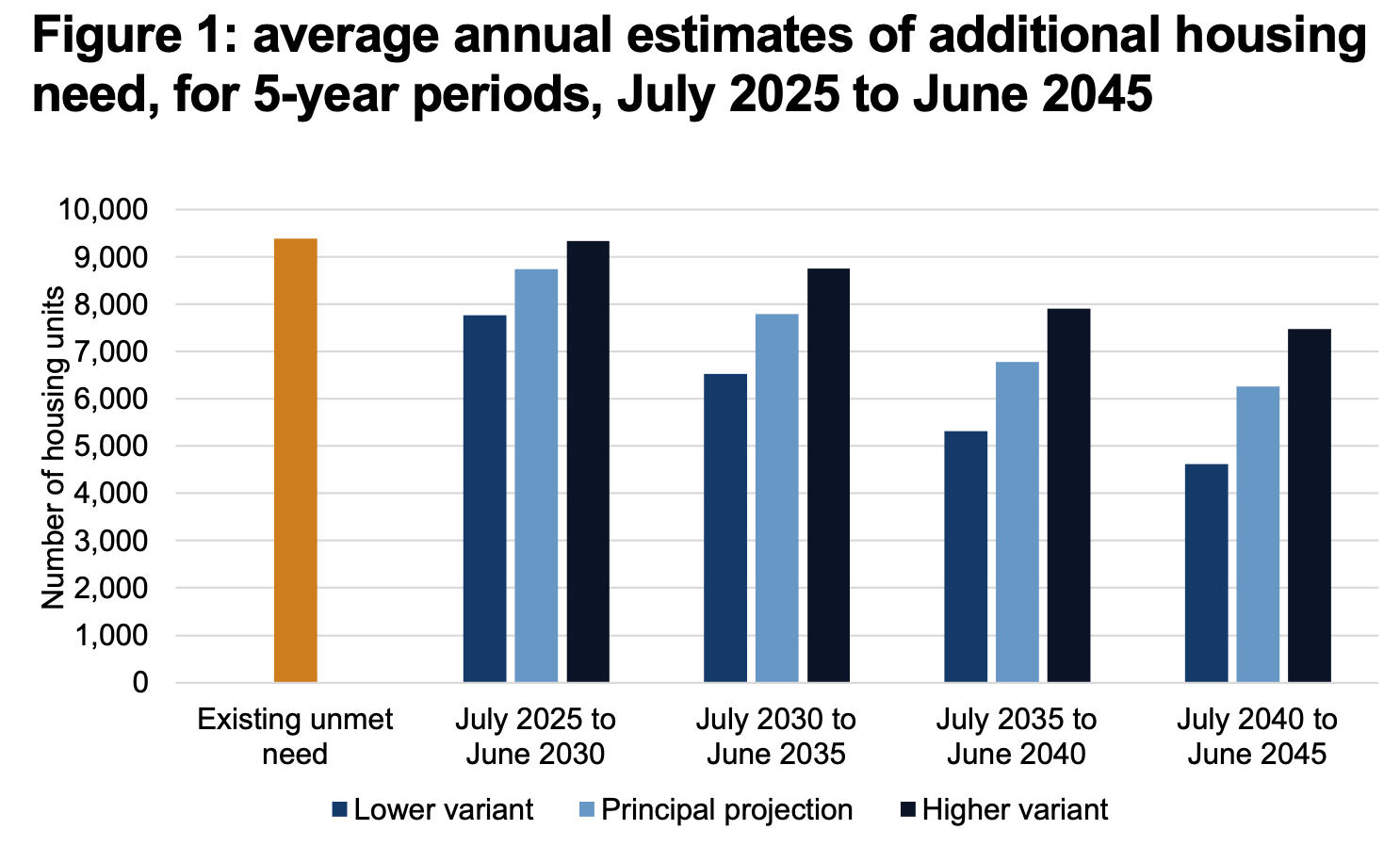
The figure for unmet existing need represents a 64 per cent increase on previous, 2019-based estimates. This is the result of more people becoming homeless and living in temporary accommodation, especially since the ‘no one left out’ approach to homelessness adopted during the pandemic.
The 8,700 a year central estimate for future housing need over the next five years represents a 38 per cent increase on the 2019-based estimate of 6,300 a year between 2019 and 2024.
This reflects higher projected household growth in 2022-based household projections published in late November. This projection was driven mostly by an increase in one-person households, especially among older people.
The estimates suggest that over the next five years, 65 per cent of newly arising need (5,700 additional homes a year) will be for market housing and 35 per cent for affordable housing (3,000). All of the unmet existing need is estimated to require affordable housing.
The previous estimates assumed that existing unmet need would be cleared within five years and projected a total need for 7,400 additional homes a year between 2019 and 2024.
On a similar basis, more than 10,500 additional homes a year would be required to meet existing and future need between 2025 and 2030.
However, the new estimates comment that: ‘Due to recent trends in the number of homeless households in temporary accommodation the technical group agree that this assumption is no longer reasonable so we present existing unmet need as a standalone snapshot, rather than spreading it over a number of years.’
Newly arising need is projected to fall gradually after 2030 with a central estimate of 6,300 a year in the early 2040s.
A blog by the chief statistician for Wales cautions that the need estimates should not be interpreted as housing targets and cannot account for future policy changes or wider economic shifts.
They are also different to local housing market assessments carried out by local authorities.
CIH Cymru director Matt Dicks said: ‘This update to the housing need data is much needed and shows the stark reality of Wales’ housing emergency with high levels of homelessness, rising demand for affordable homes and difficulty accessing market housing. Yet whilst the data does provide a useful estimate of affordable housing need, it does not provide a breakdown of the sizes and types of home that will be needed. We repeatedly hear from our members that there is a shortage of one-bed and four-bed plus homes. Our manifesto, ‘A plan for housing in Wales’, outlines that as we develop homes we also need to ensure these are of the right size and type. We need this to form part of the housing need data to ensure we can develop homes of the right type and size.’
Mark Harris, planning and policy advisor for Wales at the Home Builders Federation, said: ‘HBF welcomes the updated housing needs data, which clearly shows the importance of delivering private house building as well as affordable housing in Wales. This data is well timed as several Local Development Plans are moving forward with their reviews, and work starts on Strategic Development Plans in Wales.
‘New house building will need to more than double from current levels to meet Wales’ housing need in the years ahead. To achieve this, increasing housing supply of all tenures must be a priority for the next Welsh Government. HBF is calling for full coverage of up-to-date Local Development Plans, a further extension of Help to Buy Wales, and the restoration of Technical Advice Notice 1 or a similar mechanism.’