POLICY DEVELOPMENTS IN OTHER PARTS OF THE UK
UK
LHA freeze to continue until 2027
Chancellor Rachel Reeves scrapped the two-child limit on benefits in her Budget in November in a major move to tackle child poverty.
She also introduced higher rates of income tax on landlords’ rental income from property and a council tax surcharge on higher-value homes.
However, the Budget did not mention the overall benefit cap or Local Housing Allowance (LHA).
Confirmation that LHA rates will be frozen again for 2026/27 instead came in a written statement from work and pensions secretary Pat McFadden. The inevitable result will be increased shortfalls for tenants against rising rents.
There was also no response to pleas from local authorities for an increase in temporary accommodation subsidy, which is still linked to 90 per cent of LHA rates from 2011.
ENGLAND
Westminster sets out homelessness strategy
The Westminster government pledged to halve long-term rough sleeping and end the unlawful use of bed and breakfast accommodation for families with children as part of its ‘national strategy to end homelessness’.
While it also promised to increase the proportion of people for whom homelessness is successfully prevented, no target was set to reduce the record numbers of homeless households and children living in temporary accommodation.
And there was no sign that the UK government is prepared to follow the examples of Scotland and Wales by abolishing or reforming the priority need and intentionality tests.
However, it is considering ‘levers to require social housing landlords to rehouse statutory homeless households referred by the council, including legislation if necessary’.
And it promises more funding for councils to procure temporary accommodation and it will consider regulation of costly nightly-paid temporary accommodation.
Planning boost for new homes
A radical rewrite of England’s National Planning Policy Framework includes a permanent presumption in favour of suitably located development within settlements and a default ‘yes’ to homes near busy commuter train stations.
The UK government claimed that its third round of planning reform since it came to power could deliver ‘hundreds of thousands of new homes’ towards its target of 1.5 million in this parliament.
The default ‘yes’ will apply to ‘well-connected’ stations even if they are in the green belt provided they are built to minimum densities.
SCOTLAND
Landlords to get power to end abusers’ tenancies
A change in the law in will give social landlords greater control to transfer tenancies from domestic abusers to victims.
Regulations have been laid in the Scottish Parliament that will make it easier for victims of domestic abuse to remain safely in their homes with the tenancy in their name.
For the first time social landlords, rather than the victims themselves, will be allowed to take legal action to end an abuser’s tenancy.
Subject to Parliament’s approval the regulations will bring Part 2 of the Domestic Abuse (Protection) (Scotland) Act 2021 into force.
This will mean that from 1 August 2026, where conditions set out in the new law are met, social landlords will be able to apply for a court order to enable them to transfer a tenancy from an abusive tenant to their victim
NORTHERN IRELAND
Big rise in pensioner homelessness
Housing professionals warned of a ‘moral catastrophe’ after the number of pensioner households who are homeless and living in temporary accommodation almost doubled in a year.
Official statistics covering April to September 2025 showed that 489 pensioner households were placed in temporary accommodation, an increase of 90 per cent on a year earlier.
The primary reason for homelessness continues to be that existing accommodation is not reasonable, accounting for 1,532 accepted households. Within this, unreasonableness due to physical health issues or disability is the largest driver, affecting 1,011 households.
Justin Cartwright, national director of the Chartered Institute of Housing (CIH) Northern Ireland, said the rise was directly linked to housing failing to keep pace with people’s changing needs.
WELSH GOVERNMENT
WHQS updated for damp and mould
 The Welsh Housing Quality Standard will be updated to set out clear timescales for investigating and remedying hazards which pay present a serious risk.
The decision by housing secretary Jayne Bryant follows a consultation on proposed changes launched after the tragic death of Awaab Ishak from prolonged exposure to damp and mould and the introduction of Awaab’s Law in England.
Jayne Bryant said the measures are ‘not optional’ and are designed to strengthen accountability and transparency across the sector: ‘Social landlords must now publish response times and report on their performance as part of the WHQS compliance return, ensuring tenants can see how their landlord is meeting obligations.’
She added that the action follows recent reports by the Public Services Ombudsman for Wales (see p42-45) that highlighted ‘unacceptable failures by some social landlords to respond to damp and mould complaints’.
‘It is essential that all landlords act without delay when issues of damp and mould, as well as other hazards, are reported. This means having systems in place to respond quickly, keep tenants informed, and treat their concerns with empathy and respect, not just as technical problems.
‘Compliance with statutory requirements is the baseline, but my expectations go further. Landlords should demonstrate a proactive, person-centred approach: identifying risks before they escalate, engaging with tenants to understand their needs, and prioritising well-being. Improvements in how damp and mould issues are managed are a key expectation, and robust processes are vital to deliver safe, healthy homes for all.’
20,000 target to be delivered seven months’ late
The Welsh Government is set to miss its target of 20,000 affordable homes by the end of this Senedd term but expects to meet it by November 2026.
Official statistics show that 3,530 affordable homes were delivered towards the target in 2024/25, plus 370 long term social housing voids brought back into use. That takes cumulative delivery since April 2021 to 13,399 homes.
However, Welsh Government management information published at the same time shows that it will come closer to meeting the target than previously thought.
With a further 4,936 homes including voids expected to be delivered in 2025/26, the projected delivery is 18,652 homes (93 per cent of the target) by the end of April 2026. Cumulative delivery is expected to be 20,182 by November 2026.
Housing secretary Jayne Bryant said in a written statement: ‘When we set our target of an additional 20,000 low-carbon homes for rent in the social sector by 2026, we knew it was ambitious. But we also knew how much it mattered. That’s why we backed our commitment with over £2 billion of investment – the largest ever investment in social housing in Wales. And today’s data shows that investment is delivering results.’
More funding for ORP
The Welsh Government announced a further £14.1 million for energy efficiency improvements to social homes, taking total funding for the Optimised Retrofit Programme to £107.1 million for this year.
The programme has already funded 31,000 energy efficiency upgrades to social homes across Wales since 2020, cutting household bills whilst reducing greenhouse gas emissions.
Housing secretary Jayne Bryant announced the news at a visit to a retrofitted sheltered housing scheme in Tredegar run by Hedyn.
She met residents, including John Nicholls, a 94-year-old former missionary, whose annual energy costs have fallen significantly following his home’s upgrade.
He said: ‘I’ve lived in this flat for 30 years and it is the best it has ever been. It’s fantastic now. It’s warm and I can keep an eye on it all the time.
‘If I am out, I just use the app on my phone to switch the heating on before I get home.’
New chair for regulatory group
Housing secretary Jayne Bryant confirmed the appointment of Kalwant Grewal as the Independent Chair of the Regulatory Advisory Group (RAG) for a three-year term, extendible for a further three years, from October 2025.
The RAG is a stakeholder representative group primarily charged with improving social housing regulation by providing stakeholder input and advice in relation to regulation strategy and policy.
Kalwant Grewal has chaired audit and risk committees and finance and performance committees for several regulated organisations, providing strategic leadership on assurance, risk, and organisational performance.
He has held senior executive roles including chief financial officer and company secretary of the LHC Procurement Group and finance and risk director at the Impact Investing Institute.
WALES
Codi ‘to make a real difference’
 Linc and Pol became Codi Group at the start of January.
The new identity for the merged group was confirmed in June. The two organisations have formally come together under a single identity and shared strategy, completing what they say will be the transition into one new entity with a clear purpose and direction, focused on using collective strength to shape better futures for people and places in a sustainable, long-term way.
Scott Sanders, group chief executive of Codi Group, said: ‘The completion of the merger and transition to Codi marks a significant step forward. Codi brings together the strengths and legacies of two strong organisations with shared values and deep community roots, giving us the size and scale to make a real difference while staying local to the communities we work in.’
Boost for Bridgend
Valleys to Coast has been awarded £1.7 million through the Welsh Government’s Transforming Towns programme to bring new life and purpose to Wyndham House, an important building in Bridgend town centre.
The redevelopment plans include new and improved commercial units, modern workspace, and high-quality town centre homes, helping to create a more vibrant, lived-in, and sustainable town.
The project is designed to deliver long-lasting social, economic and physical benefits for the community, including greater footfall to boost the local economy with a 300-plus workforce visiting the office every week, updated commercial spaces that are attractive to local businesses, and new homes in the heart of Bridgend that support a thriving, lived-in town centre.
Construction began in October, and key milestones and completion dates will be shared as the project moves into the delivery phase this year.
Fund is transforming derelict land
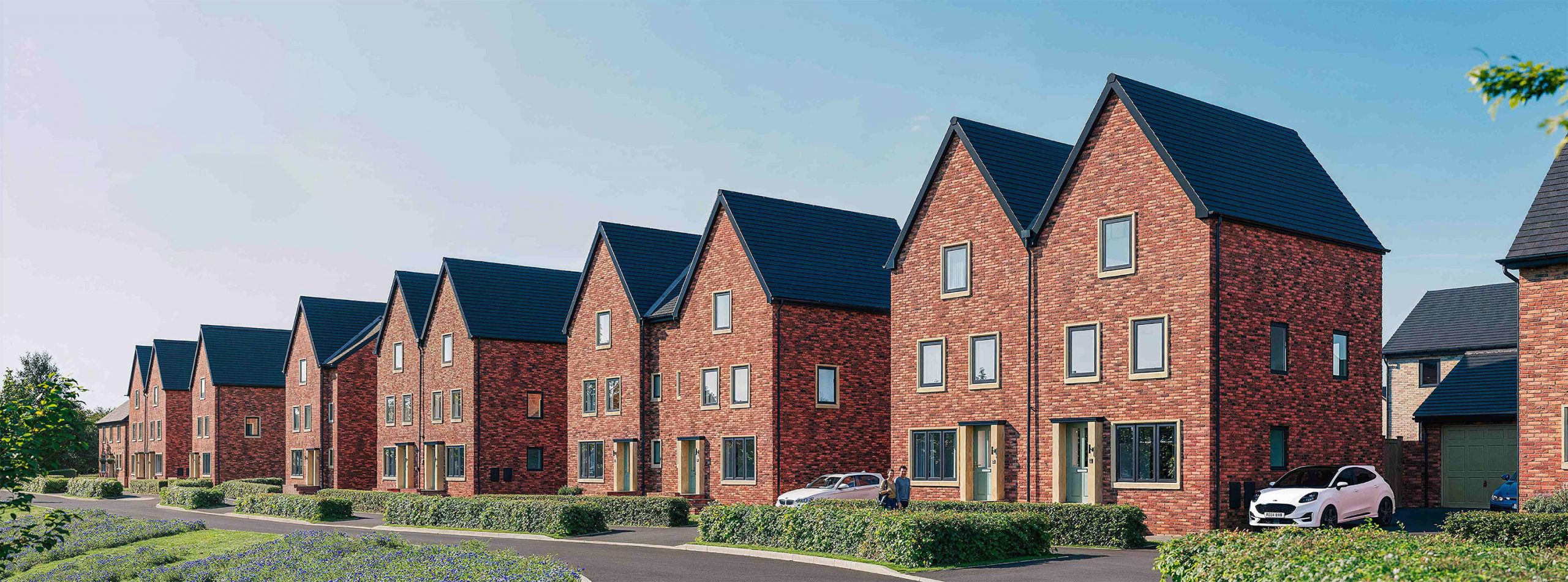
A major Cardiff Capital Region (CCR) funding programme is transforming derelict land into new communities, delivering 2,500 homes and supporting more than 3,000 jobs across South-East Wales.
The £35 million Housing Viability Gap Fund (HVGF) has so far supported 14 housing developments across nine local authorities, tackling one of the biggest barriers to regeneration: the prohibitive cost of remediating brownfield sites that would otherwise remain undeveloped and addressing housing need.
Nine projects have already fully drawn their funding allocation, with a further five in progress. All include affordable housing as part of their mix, with the overall proportion currently being finalised.
One of the most visible examples of the fund in action is Dragon Park, a 200-home mixed-tenure development in Abercanaid, Merthyr Tydfil. The site is now being released for sales and is marketed as Dol-Y-Ddraig.
Delivered by local builder Davies Homes with support from a £3.5 million CCR grant, the project sits within the Hoover Strategic Regeneration Area, a zone long associated with Merthyr’s industrial heritage. Work on site is well under way and will continue in phases until 2030, with 10 percent of the homes being delivered as affordable homes.
Mike Brough, regional growth director at Cardiff Capital Region, said: ‘At Dragon Park, we are seeing local builders creating high-quality, mixed-tenure housing that meets regional need and keeps economic benefit in the community.
‘It is a perfect example of how CCR investment turns ambition into real-world outcomes. This is regional investment in action. It is practical, visible regeneration that connects our industrial past to our housing future.’
Council paves way for Caerphilly homes

Caerphilly County Borough Council confirmed that remediation and groundworks at the former Windsor Colliery site have now been completed, paving the way for the second phase of construction to begin on a major 152-home development delivered by United Welsh.
The mixed-tenure scheme will provide 70 per cent affordable housing, including general needs homes and properties for intermediate rent, alongside high-quality accommodation for single residents. The remaining homes will be delivered as open market sale through United Welsh’s sales brand, Harmoni Homes.
Supported by Welsh Government through Social Housing Grant and Housing Viability Gap Funding from the Cardiff Capital Region, the project represents a significant investment in the local community.
The homes will be built by Celtic Offsite, a social enterprise within the United Welsh Group. Celtic Offsite will manufacture the timber frame structures from its factory in Caerphilly, with the homes being completed on-site by contractor M&J Cosgrove.
Love takes the helm at Bron Afon
 Catherine Love takes over as chief executive of Bron Afon Community Housing in early February on the retirement of Alan Brunt.
She first joined Bron Afon in 2019 as director of customer experience and became executive director of operations and deputy chief executive in 2023.
Her appointment followed a recruitment process involving board members, colleagues and customers.
Bron Afon chair Craig Nowell said: ‘The selection panel unanimously agreed that Catherine’s passion for, and knowledge of the Welsh housing sector, our customers and communities, gave the board confidence that she can build on Bron Afon’s success and provide the necessary transformation leadership to focus on and deliver our ambitions.;
Alan Brunt added: ‘I’ve had the pleasure of working with Catherine since she started at Bron Afon. She is a valued member of our senior leadership team and I’ve seen first hand her passion for our customers, communities and colleagues.’

ClwydAlyn residents move into Bodelwyddyn properties.
Sarah Alcock was one of the first residents to move into their new homes at ClwydAlyn’s Maes Y Llan development in Bodelwyddan in Denbighshire in time for Christmas.
Residents moved into 21 new homes at the £11 million development, with the remaining 24 homes scheduled be finished in the New Year. The scheme of is being built by K&C Construction as part of Denbighshire County Council’s Local Development Plan (LDP). The mixture of new properties in phase one comprises 17 two and three bedroomed homes as well as 16 one and two bedroomed apartments.
All homes at Maes Y Llan are built using modern methods of construction (MMC) and feature high levels of insulation, with air source heat pumps to provide heating and hot water. The homes also boast solar electricity panels and are positioned to maximise solar gain and natural daylight.
PUBLICATIONS 10 TO LOOK OUT FOR
1) Local Housing Allowance: a safety net unravelling
Shelter Cymru, November 2025
sheltercymru.org.uk/policy_and_research/local-housing-allowance-a-safety-net-unravelling/
2) Criminal landlords in the shadow private rented sector in England
University of York, December 2025
eprints.whiterose.ac.uk/id/eprint/235030/
3) A national plan to end homelessness
Ministry of Housing, Communities and Local Government, December 2025
4) New lessons for new towns
housingforum.org.uk/reports/key-publications/new-lessons-for-new-towns/
The Housing Forum, October 2025
5) Forward planning: a vision of ageing at home
Fabian Society, Centre for Ageing Better, November 2025
fabians.org.uk/publication/forward-planning/
6) Flat Britain: The urban density gap and how to close it
Centre for Cities, November 2025
www.centreforcities.org/publication/flat-britain-the-urban-density-gap-and-how-to-close-it/
7) Late movers: how the shortage of housing affects our ageing population
Age UK, October 2025
8) How do house prices affect social mobility?
Institute for Fiscal Studies, January 2026
ifs.org.uk/publications/how-do-house-prices-affect-social-mobility
9) Restoring security: Understanding the effects of removing the two-child limit across the UK
Institute for Public Policy Research, December 2025
10) 2025 UK Housing Review Autumn briefing paper
Chartered Institute of Housing etc, October 2025
www.cih.org/publications/2025-uk-housing-review-autumn-briefing-paper/